Use of home as office: the quick answer for limited company directors
Use of home as office, for a UK limited company director in 2026/27, comes down to three routes. Your company can pay you a £6/week flat-rate allowance with no receipts required, an actual-costs claim based on the genuine proportion of household bills your office uses, or set up a formal rental agreement where the company pays you market-rate rent for the space. Each is Corporation Tax deductible for the company, and each suits a different working pattern.
The method most directors default to, the £6/week flat rate, is also usually the one that claims the least. It is one of several ways to take money out of your company besides salary and dividends: see how to pay yourself from a limited company for the full picture. It is worth a few minutes working out whether actual costs or a rental agreement would put more money back through the company instead, especially if you work from home most of the week.
Three ways to claim home office costs through your limited company
As a director, you are an employee of your own company, not self-employed, so the self-employed "simplified expenses" rules for sole traders do not apply to you directly. Instead, your company reimburses or pays you under employment-income rules, and it can do that in one of three ways.
Home costs you have paid personally and your company has not yet reimbursed sit as a credit balance on your director's loan account, which the company can repay you tax-free whenever it has the cash. Be careful not to reimburse more than you are owed: an overpayment turns the credit into an overdrawn balance, and one still outstanding nine months after the year end attracts the section 455 charge at 35.75%.
Plenty of directors combine a home office with a coworking desk rather than picking one. Our guide to whether coworking space is tax deductible covers how the Corporation Tax deduction and the VAT reclaim work on a coworking membership, including why VAT behaves differently there than it does on home running costs.
Method 1: The £6/week flat rate
Your company pays you £6/week (£312/year), tax-free and National-Insurance-free, with no receipts or detailed calculations needed, provided a homeworking arrangement genuinely exists between you and the company (an email confirming the arrangement is enough). It is the simplest option and the one HMRC scrutinises least, because it is a fixed, published figure rather than a claim you have calculated yourself.
Method 2: Actual costs, apportioned
If £6/week clearly undershoots your real costs, your company can instead pay a proportion of genuinely variable household running costs: heating, electricity, water, and business broadband. Work out the business-use percentage by floor space and time, then apply that percentage to the relevant bills.
Fixed costs you would pay regardless of where you worked, rent or mortgage interest, Council Tax, buildings insurance, generally are not allowable under this method, because they are not additional costs caused by working from home. That is what separates this method from the rental agreement below.
Method 3: A formal rental agreement
You personally rent office space to your own company under a written licence or rental agreement, at market-rate rent. This is the only route that lets the company claim a share of fixed costs, rent, mortgage interest, Council Tax, on top of the variable ones, because the payment is genuine rent for genuine business premises rather than an expense reimbursement. It claims the most, but it comes with two conditions: the rent you receive is personal income you must declare on Self Assessment, and a room used exclusively for business can put a slice of your Private Residence Relief at risk when you sell, covered in the section below.
Which method wins: a worked example
Take a freelance video editor who incorporated in 2025, working from a converted spare bedroom in a three-bedroom house three days a week (2026/27), with the room also used as a guest room at weekends. Her household bills for heating, electricity, water, and broadband come to roughly £3,200 a year, and the office room is about 12% of the home's floor space.
On the flat rate, her company pays her £312 for the year. On actual costs, apportioning 12% of the room for the three of seven days a week she uses it works out to £3,200 x 12% x 3/7, roughly £165 for the year, below the flat rate once part-time use is properly time-apportioned. Compare a second director in a larger home working from a dedicated office five or more days a week, with £6,000 a year in household bills and a room making up 20% of the floor space: £6,000 x 20% x 5/7 comes to roughly £857, comfortably above the flat rate. The variables that decide it are household bill size, room size, and how many days a week the room is genuinely a workspace. Chapter 10 of Busy, Not Rich, our book for UK creative business owners, collects claims like this one that a company is entitled to and often never makes, from home office costs to capital allowances.
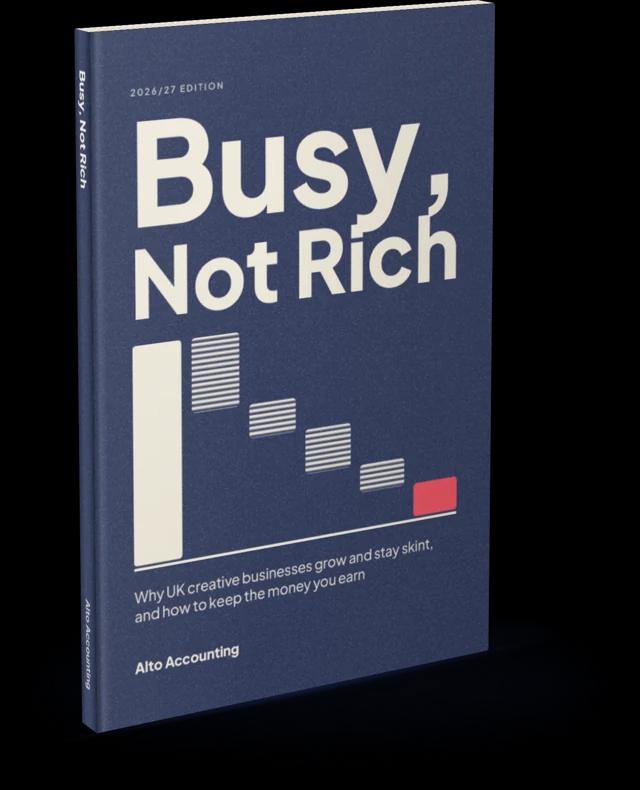
Busy, Not Rich: the free kit
Our book on why UK creative businesses grow and stay skint. The kit puts every chapter's exercise in a workbook for your own numbers, with the 2026/27 tax rates on one page.
Get the free kitThe pattern that matters
Part-time or occasional home working rarely beats the £6/week flat rate once time is properly apportioned. Full-time home working, especially with a dedicated studio or edit suite with real running costs, usually does. Run your own numbers before assuming the flat rate is the easy win, since "easy" and "most" are not the same thing here.
Find the salary and dividend split that keeps the most of your profit for 2026/27, and see how it compares with staying a sole trader. Work out your take-home.
The CGT and business rates trap directors miss
HMRC restricts Private Residence Relief where part of a home is used exclusively for business purposes, under section 224(1) of the Taxation of Chargeable Gains Act 1992. If a room in your house is 100% office, with no personal use at all, the matching slice of any gain on that property becomes chargeable to Capital Gains Tax when you sell, rather than fully covered by the relief that normally shelters your main home.
The fix costs nothing: keep genuine dual use. A spare room that also sleeps guests occasionally, or a garden office also used as a gym or hobby space some evenings, is not exclusive business use, so the restriction should not bite. HMRC has confirmed that minor private use of an otherwise business room is disregarded, but a room with literally no personal use at all is the scenario that triggers the restriction. If the room is a detached building, see whether your company can pay for a garden office and what it can claim.
Business rates: the second, rarer trigger
Separately, the Valuation Office Agency can assess part of a home for business rates rather than Council Tax in specific situations: clients or customers regularly visiting the property, structural modifications made for the business, employees working at the property alongside you, or a mixed-use property such as living above your own shop. An occasional home office, even used most of the working week, is very unlikely to trigger this. A converted garage running as a small studio with clients visiting weekly is a genuine risk case. If clients or customers visit your home office regularly, check with the Valuation Office Agency before assuming Council Tax alone still applies.
Is your company paying you the right way?
Some directors are still trying to self-claim WFH relief personally instead of having the company pay it, which is both the less tax-efficient route and, from April 2026, a dead end.
What changed in April 2026 (and why it doesn't touch you)
From 6 April 2026, HMRC removed the ability for employees to claim Income Tax relief on non-reimbursed homeworking costs through Self Assessment or form P87, a route roughly 300,000 people used to self-claim the £6/week allowance when their employer did not pay it. The government's own impact note puts the cost of losing that relief at £62 a year for a basic rate taxpayer and £124 a year for a higher rate taxpayer.
The scrapped relief only ever affected employees claiming personally, for costs their employer never reimbursed. It does not affect employer-paid amounts at all. GOV.UK is explicit that this measure "will not impact the existing ability for employers that reimburse employees for costs relating to homeworking." As the director of your own limited company, the company paying you the £6/week flat rate directly (or more, under the actual costs or rental methods set out above) was never the claim that got removed.
Nothing changes for you here, provided you were already doing it the smart way: through the company, not through a personal Self Assessment claim. If you also employ staff who work from home, the same reimbursement route applies to them, and our guide to the working from home allowance for employees covers how an agency sets the rate and the payroll coding.
Equipment, broadband, and VAT on home office costs
Office equipment bought and invoiced directly in the company's name, a desk, a monitor, a proper chair, a business laptop, is a straightforward company expense separate from the £6/week flat rate, actual costs, and rental agreement methods for claiming running costs, and typically qualifies for full relief against Corporation Tax in the year of purchase under the Annual Investment Allowance, which covers up to £1m of plant and machinery in year one (2026/27). Our Annual Investment Allowance guide covers what qualifies and how to claim it, including the personal-use test that applies when equipment is used for both business and private purposes. For cameras, laptops, and studio kit specifically, including the ongoing benefit-in-kind cost of personal use, see our guide to buying equipment through a limited company. A photographer running a home studio can see how the kit, VAT and incorporation questions fit together in our guide to what an accountant for photographers should check.
VAT is where limited companies come off worse than sole traders on this topic. A sole trader can typically reclaim a proportion of VAT on household bills like heating and electricity. A limited company generally cannot, because the utility contract is in the director's personal name, not the company's, so there is no VAT invoice addressed to a VAT-registered entity to reclaim against. The rental agreement route does not fix this either, since domestic rent is VAT-exempt. Where a company genuinely can reclaim VAT is on business-specific costs taken out directly in its own name: a business broadband contract, equipment purchases, and office supplies bought on the company's account. If this VAT gap is part of what you are weighing before incorporating, our sole trader vs limited company guide sets it against the tax, liability and running-cost differences.
For the full picture of what else your limited company can and cannot claim, from mileage to client entertainment to professional subscriptions, see our limited company expenses guide. If you are also weighing up a staff Christmas dinner or summer social against the £150 annual exemption, our business entertainment expenses guide covers where a director-only company can pass the Income Tax test but still lose the VAT.
Whichever method you use, the claim only holds up at year end if the receipts, mileage log, or rental agreement paperwork behind it is actually kept and reconciled through the year, not reconstructed from memory in March. That is routine bookkeeping work, and our guide to what bookkeeping services cost covers what a director should expect to pay to have it done properly, and our guide to how much an accountant costs for a limited company shows where bookkeeping sits in a full package.
If you would rather have all of this handled for you, Alto's accountants for creative freelancers keep the receipts, the VAT position, and the year-end accounts in order alongside the day-to-day bookkeeping.
Home office costs are small next to the sums a director can move out of the company tax-efficiently. The bigger lever is usually company pension contributions for a limited company director, which cut Corporation Tax without passing through your personal income.
Book a 30-minute call and we will tell you honestly, based on your actual working pattern and household costs, which of the three methods puts the most money back through your company.
Key figures used in this briefing
Employer-paid working from home flat rate
Weekly flat-rate allowance a company can pay a director or employee tax-free for working from home, no receipts required (£312/year). Unchanged from 2020/21 and unaffected by the 6 April 2026 removal of employee self-claimed relief for non-reimbursed homeworking costs, since this is an employer-paid amount, not a personal claim
Extra tax from losing unreimbursed WFH relief (from 6 April 2026)
Estimated extra Income Tax facing employees who previously self-claimed the £6/week working from home allowance via Self Assessment or form P87 for non-reimbursed costs: £62/year for basic rate taxpayers, £124/year for higher rate taxpayers. Does not apply where a company pays the allowance directly to its own director
Frequently asked questions
Can my company pay for a coworking membership as well as home office costs?
Yes. A coworking or hot-desk membership used for the business is an allowable office cost in its own right, deductible against Corporation Tax, with the VAT reclaimable on a proper invoice if the company is registered. It does not cancel a genuine use-of-home claim: plenty of freelancers work from home some days and a coworking space on others, and both costs are allowable where each reflects real business use. The claim belongs to the company, so pay for the membership from the company account with the contract in the company's name. The one edge to watch is a membership bundled with genuinely personal perks (a gym, social events priced into a premium tier): the working-space element is the business cost, and a tier chosen for the perks invites the same dual-purpose challenge as any other mixed spend.
How much can I claim for use of home as office as a limited company director?
It depends on the method and how much of the week you genuinely use the space. The flat rate is £6/week (£312/year) with no receipts needed. The actual costs method apportions your genuine household running costs (heating, electricity, broadband, water) by the space and time your office takes up: for a room used a few days a week, this often lands below the flat rate once time is properly apportioned, but for a full-time home office or a dedicated studio with heavy equipment, it typically lands between £500 and £2,000+ a year, well above the flat rate. A formal rental agreement can claim the most, because it adds a slice of fixed costs like rent, mortgage interest, and Council Tax on top, but it comes with more admin and a genuine Capital Gains Tax consideration covered below. There is no single right answer: it is worth running your actual numbers rather than defaulting to the flat rate out of habit.
Can I claim the £6 a week working from home allowance as a director?
Yes. Your company can pay you £6/week (£312/year) tax-free and National-Insurance-free, with no receipts or calculations required, and it is Corporation Tax deductible for the company. This is unaffected by the removal of the employee self-claimed homeworking relief from 6 April 2026, because that change only stops individuals claiming unreimbursed costs through Self Assessment or form P87. A company paying its own director directly was never using that route, so nothing changes for you here.
Do I have to pay tax on rent my company pays me for using my home as an office?
Yes, if you use the formal rental agreement route. Rent your company pays you for office space is personal rental income, which you must declare on your Self Assessment tax return, though you can offset a reasonable proportion of your own household costs against it to reduce the taxable amount. HMRC expects the rent to reflect genuine market-rate business use of the space, not an inflated figure designed to extract profit tax-efficiently. A written licence or rental agreement between you and your company protects both sides if HMRC ever asks questions, and without one, HMRC can treat the payments as additional salary or a distribution instead.
Will claiming home office expenses affect Capital Gains Tax when I sell my house?
Only if a room is used exclusively for business, with no personal use at all. HMRC restricts Private Residence Relief under the exclusive-use rule (TCGA 1992, s224), so a room that is 100% office, all the time, can lose you relief on the matching slice of any gain when you eventually sell. The fix is simple: keep genuine dual use. A spare room that doubles as a guest room some weekends, or a garden office also used as a gym in the evenings, does not count as exclusive use, so the CGT restriction should not apply. This is one of the most commonly missed traps in home office planning, because directors optimise the expense claim without checking what it does to the eventual house sale.
Can my limited company claim VAT on home office costs?
Rarely, and this is one of the biggest differences between a sole trader and a limited company on this topic. Sole traders can typically reclaim a proportion of VAT on household bills like heating and electricity. A limited company generally cannot, because the utility contracts are in your personal name, not the company's, so the VAT invoice is not addressed to a VAT-registered entity that can reclaim it. The formal rental agreement route does not fix this either, since domestic rent is VAT-exempt. Where your company genuinely can reclaim VAT is on office equipment and supplies bought and invoiced directly in the company's name: a desk, a monitor, a business broadband contract taken out by the company itself.
In short
- Three methods exist, and the flat rate usually claims the least. £6/week, actual proportionate costs, or a formal rental agreement: pick based on how much space and time you genuinely use.
- The rental agreement claims the most but adds admin. Personal rental income to declare, a written agreement to put in place, and a Capital Gains Tax condition to watch.
- Keep any claimed room on dual use. 100% exclusive business use is what puts Private Residence Relief at risk on sale, not moderate or even heavy business use alongside some personal use.
- April 2026's relief removal does not touch directors. It only stops employees self-claiming unreimbursed costs personally. Your company paying you directly was never that route.
Sources & method
Every rate, threshold, and rule is sourced to GOV.UK below. Worked-example figures are Alto's own illustrative estimates, not GOV.UK figures.