Deciding whether a specialist is worth the fee? Book a free 30-minute consultation to see what we would flag in your numbers before you commit to a quote.
UK Accountant Costs at a Glance
For 2026, published UK price guides from Sleek, DIGI Accounting and TaxPound agree on the shape of the market even where their exact figures differ. The sole trader figure comes from our own self assessment accountant cost guide. They are accountancy firms' own price pages, so read them as indicative ranges, not quotes.
UK accountant fee ranges, 2026
- Sole trader self-assessment return: about £150-500 per return
- Limited company, annual-only (accounts and corporation tax return): about £500-1,500 per year
- Small limited company (simple finances at the lower end): about £60-250 per month
- Limited company with VAT, payroll and bookkeeping: about £150-400 per month
- Limited company with management accounts and tax planning: about £250-750+ per month
- Hourly work (HMRC enquiries, restructures, specialist advice): about £50-300 per hour
- Outsourced FD: FD Capital, a UK finance director recruiter, prices one day a week at £2,400-£4,800 per month for businesses turning over £1m-£5m (published rate card, checked October 2026)
Check that any firm you shortlist holds a practising certificate. The ACCA register is searchable, and an unregulated individual charging well below these ranges may not carry professional indemnity insurance.
How much does an accountant cost for a limited company?
A small limited company typically pays about £60-250 a month, simple finances at the lower end, for year-end statutory accounts, the corporation tax return (CT600) and the confirmation statement; a director self-assessment return is often included but some firms price it separately. If you only want the year-end work, expect about £500-1,500 a year. Statutory charges sit outside the accountant's fee: Companies House charges £50 to file the confirmation statement online; our Companies House fees guide lists every fee and what a company pays in a year.
Limited company accounts cost more as the scope grows: a company with VAT returns, payroll and bookkeeping is quoted at about £150-400 a month, and one that also wants monthly management accounts and tax planning at £250-750 or more. The same company on a £60 quote and a £250 quote is usually being offered different jobs, not different prices for the same job.
For the VAT return line on its own, see what an accountant charges for a VAT return, which covers what makes an agency's fee higher.
A limited company needs more filings than a sole trader: year-end accounts, a corporation tax return (CT600), a Companies House confirmation statement and, with staff, payroll. That is why the fee sits above a sole trader's self-assessment.
Most limited companies are better off with a fixed monthly package than paying per service. A package in the middle of the VAT-and-payroll tier covers:
- Annual statutory accounts prepared and filed at Companies House
- Corporation tax return (CT600) submitted to HMRC
- Monthly payroll with RTI submissions and P60s
- Quarterly VAT returns
- Confirmation statement filing
- One director self-assessment return
Adding monthly management accounts and a quarterly advisory review moves a package into the top tier. What you are buying there is a current P&L every month, a salary and dividend split checked against current thresholds, and a prompt about pension contributions or capital purchases before year end.
What moves a limited company's fee up or down is mostly scope and tidiness. Payroll, VAT registration (see the VAT registration threshold), more than one director self-assessment return and monthly management accounts all add cost. Clean Xero bookkeeping, no payroll and a single director keep it near the bottom of the range. The confirmation statement is usually included in a package, and the director salary and dividend split is where an advisory-level accountant earns the extra fee.
Most of the fee itself is also deductible, which reduces the real cost further. See our guide to which part of an accountancy invoice is tax deductible for exactly what HMRC allows and what it does not, and the worked example below for what the deduction is worth.
If your company is not trading at all, none of the above applies at full price. A dormant company still has to file accounts and a confirmation statement every year, but there is no payroll, no VAT return, and no CT600 to prepare, so the fee drops well below a trading company's. See our dormant company accounts guide for the full filing requirements and the cost comparison against dissolving the company instead.
What Affects Accountant Fees in the UK?
Five factors drive the gap between the bottom and the top of the ranges above.
Business structure. A sole trader with one income source needs a fraction of the work of a limited company with multiple directors, payroll, and VAT-registered trading. The jump from sole trader to limited company adds the year-end accounts, corporation tax return and confirmation statement. See the guide on sole trader vs limited company if you are weighing the accounting cost as part of that decision.
Revenue and transaction volume. A £60k agency with six retainer clients and clean Xero bookkeeping is straightforward to account for. A £600k agency billing project fees, managing media passthrough, running payroll for 12 staff, and claiming R&D tax credits is substantially more complex. Quotes follow the number of transactions, employees and VAT returns more than the revenue figure alone.
Services included. Basic compliance packages cover annual accounts, the corporation tax return and a director self-assessment. Full-service packages add payroll, monthly bookkeeping, VAT returns, management accounts, and director tax reviews. Each added service increases the monthly fee but also increases the value delivered.
Specialism. A practice that works mainly with agencies or other creative businesses can quote above a general high-street firm, because the work includes industry-specific issues such as VAT on media spend, pass-through costs and work in progress. Ask what the extra fee buys you in practice, not just what it costs.
Advisory depth. Compliance accountants minimise their time on your affairs. Advisory accountants proactively contact you when tax legislation changes, when allowances you can claim arise, and when your numbers suggest a problem. The cost difference is real; so is the value gap.
Is accounting software included in the fee?
Often not. Many firms quote their fee on the basis that you pay for your own cloud ledger, which for a small limited company was listed at about £24-£70 a month for the mid-range plans an agency would pick, at standard prices before introductory discounts, on the plan pages we read in October 2026 (Zoho Books, FreeAgent, QuickBooks and Xero; entry plans start lower, and not every vendor states whether VAT is included). Some online accountants bundle their own software into the monthly price instead, which looks cheaper but leaves your books in a system you cannot take with you. Ask every firm whether software is in the quote, and compare like with like. Our comparison of accounting software for UK agencies sets out which plan an agency needs and what each costs.
Does Location Affect Accountant Fees in the UK?
Location moves the quote. TaxPound's 2026 guide puts a London traditional firm at £250-500 a month and a regional firm at £150-250, and an online accountant at £80-150 a month against £200-400 for a traditional one. The same guide treats those as general ranges, not like-for-like quotes, so test any gap against the scope on the quote.
Almost all limited company compliance and advisory work is now delivered remotely: bookkeeping runs through cloud software, meetings happen by video call, and filings go to HMRC and Companies House online. If a quote looks high for the scope described, ask whether part of the price is a location premium for work that does not need a particular postcode to get done well.
Hidden Costs to Watch For When Comparing Accountant Quotes
A headline monthly fee rarely tells the whole story. Before signing, ask each firm to confirm the following in writing -- the cheapest quote on paper is not always the cheapest year in practice:
- Introductory-year pricing. Some firms discount the first 12 months and increase the fee once you are an established client. Ask what the fee becomes after year one.
- Transaction or payroll caps. A monthly package often assumes a transaction volume or headcount ceiling. Growing past it can trigger an extra charge mid-year rather than waiting for renewal.
- One-off Companies House filings. Share allotments, a change of registered office, or a new director appointment are sometimes billed separately from the core monthly package.
- Ad-hoc advice. Some firms charge by the email or the call for anything outside the agreed scope, which discourages you from asking the questions that would actually save you money.
- Extra people and filings. TaxPound lists £100-200 a year for each additional director self-assessment return and £50-150 a year for company secretarial work, both usually outside the base package.
- HMRC enquiry support. Check whether responding to an HMRC compliance check or enquiry is included in the package, or billed separately at an hourly rate.
How to pay less for the same scope of work
The biggest saving is rarely a cheaper firm. It is handing over work that takes less time to process, because every quote above is built on the hours the accountant expects to spend on your records.
- Keep the books current. Reconciling bank feeds and coding transactions each month avoids a year-end clean-up. If records are months behind, expect the rebuild to be priced on top of the package, usually by the hour.
- Do not pay for your self-assessment twice. Many limited company packages include one director's return, because the salary and dividend figures already sit in the books. Check yours: a director who also pays for a standalone return may be duplicating work; our self assessment accountant cost guide explains how that overspend happens.
- Buy the tier you will use. A company with no staff and no VAT registration does not need the payroll and VAT lines. Add management accounts when you act on them, not because they are offered.
- Ask for a fixed fee in writing. A fixed monthly fee with a stated scope stops scope creep on the accountant's side, and a stated volume cap tells you when the price will change.
If you are unsure whether you need a bookkeeper, an accountant, or a combination of both, see the bookkeeper vs accountant guide for UK agencies, which covers scope, cost, and the right point to introduce each one.
Accountant Costs for Sole Traders and Freelancers
A sole trader self-assessment return typically costs £150-500 with a UK accountant. At the lower end, you get a straightforward tax return with basic trading income and expenses. At the upper end, the accountant handles more complex affairs: multiple income sources, rental income, or capital gains. See our full breakdown of self assessment accountant costs for pricing by client type, and the specific overspend limited company directors make when they pay for this separately.
Freelancers who also need regular bookkeeping support should price it as a separate line: the 2026 guides quote about £30-100 a month for low transaction volumes. That gives you regular account reconciliation, a clean set of records for self-assessment, and a review of claimable expenses. If your turnover approaches the £90,000 VAT registration threshold, add VAT registration and quarterly returns to the scope -- the guides quote about £20-60 a month, or £30-150 per return.
Photographers and other equipment-heavy creative freelancers should weigh cost against specialism, not just price. Our accountant for photographers guide covers the VAT category and equipment-purchase checks that a generalist accountant at the low end of this range often skips.
Answer a few questions, get an estimated monthly fee. Get your quote.
A worked example: a £400k creative agency with VAT and payroll
Agencies need more than a freelancer does: pass-through media spend, work in progress, payroll for a team and VAT. To see what that adds up to, take a creative agency that is VAT-registered, runs payroll for six people and wants bookkeeping and monthly management accounts. Pricing each job at the ranges quoted in the TaxPound and DIGI Accounting 2026 guides gives the figures below. Those are small-company tiers, so an agency of this size can sit above them:
Monthly fee, built line by line
- Year-end accounts, corporation tax return and one director self-assessment: £80-£120 per month
- Payroll for five to ten employees: £50-£150 per month
- VAT returns: £20-£60 per month
- Bookkeeping (lower transaction volume): £30-£100 per month
- Monthly management accounts: £50-£150 per month
- Total: £230-£580 per month, or £2,760-£6,960 per year
That is close to the £250-£600 a month in this article's title, while a bare-bones quote for the same agency would leave out most of these lines. The fee is also not the net cost. The mid-point of the range above, £4,860 a year, is mostly deductible against corporation tax. For 2026/27, deducting it saves £923 for a company with £40,000 of profit before the fee (the 19% small profits rate), £1,288 at £100,000 (inside the marginal relief band, where the marginal rate is 26.5%) and £1,215 at £300,000 (the 25% main rate). The GOV.UK marginal relief guidance sets the thresholds.
Want to know what the right accountant would save you?
Get a free consultation: 30 minutes on your actual numbers with a chartered certified accountant.
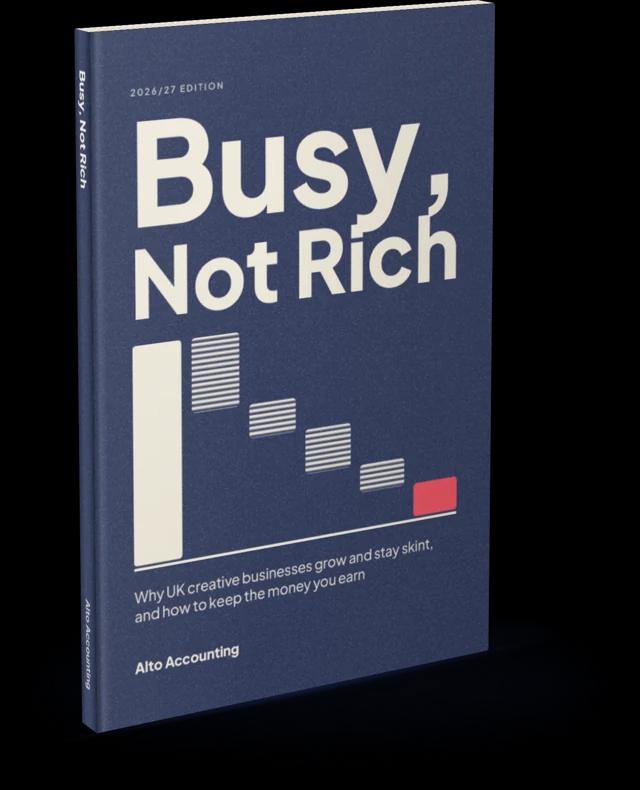
If your current accountant does not know your agency's gross margin, has never mentioned R&D tax credits, and sends you annual accounts nine months late, you are likely overpaying for what you are getting regardless of the monthly fee. See the guide on when to switch your agency accountant for the specific signs. Chapter 14 of Busy, Not Rich, our book for UK creative business owners, covers the point at which a growing studio or agency outgrows its bookkeeper and what to ask of the support that comes next.
Busy, Not Rich: the free kit
Our book on why UK creative businesses grow and stay skint. The kit puts every chapter's exercise in a workbook for your own numbers, with the 2026/27 tax rates on one page.
Get the free kitHourly Rate vs Fixed Fee vs Monthly Package
UK accountants use three main pricing models, each suited to different situations.
Fixed annual fee. Common for sole traders and simple limited companies. You pay one amount per year for a defined set of services. The risk is that it can feel disconnected -- you have one review per year and may avoid calling the accountant between them for fear of an extra charge.
Fixed monthly retainer. The most common model for growing businesses. A set monthly fee covers everything in scope. This encourages regular contact because you are not charged per email. It is also easier on cash flow, because the fee is spread over 12 months rather than arriving as one annual invoice.
Hourly rate. The 2026 guides quote about £50-300 per hour depending on the firm's size, location and seniority. Hourly billing works for genuinely ad-hoc work: a one-off R&D tax credit claim, a HMRC enquiry response, or due diligence for an acquisition. For ongoing accounting, hourly billing creates perverse incentives -- the accountant earns more by taking longer, and you hesitate to call when you have a question.
For most small businesses and agencies, a fixed monthly retainer is the right structure. Use the salary and dividend calculator to see what your own director pay structure costs in tax, then ask each firm how it would review it each year.
Tax figures your accountant helps you navigate
These are the 2026/27 figures that a fee conversation usually turns on: the corporation tax rate that sets what the deduction is worth, the director salary level, and the Employment Allowance.
Corporation Tax Main Rate
For profits over £250,000
Optimal Director Salary 2026/27
Personal allowance threshold - zero income tax, qualifies for NI
Employment Allowance 2026/27
Annual allowance that reduces employer Class 1 National Insurance Contributions (NIC) liability. No payroll-size cap for most employers, but a company where the director is the only employee paid above the secondary threshold cannot claim it.
Is It Worth Getting an Accountant in the UK?
For a sole trader with simple, single-source income, a self-assessment return from an accountant may cost more than the tax it saves. Many in that position file their own using HMRC's free tools, though whether a spreadsheet or free software is enough on its own now depends on Making Tax Digital: see our guide to whether you need accounting software as a sole trader for the income thresholds that make software mandatory rather than optional.
For anyone running a limited company, the question is different because the filings are not optional. If you have just gone Ltd and are still weighing this up, our guide to whether you legally need an accountant when going limited breaks down which jobs DIY freelancers get wrong, and what those mistakes cost. For the fuller cost-versus-time comparison, including where DIY filing breaks down, see our DIY vs accountant comparison.
The Employment Allowance is worth up to £10,500 off employer NI for 2026/27 where a company is eligible. It is not available where the director is the only employee paid above the secondary threshold, and the GOV.UK eligibility rules list the other exclusions. Ask any accountant you are considering whether they check it.
HMRC late filing penalties start at £100 for self-assessment returns and rise with delay, and unpaid tax accrues late-payment interest. Late payroll (RTI) filings can trigger penalties. Part of what you pay an accountant for is that nothing is late.
For agencies specifically, R&D tax credits are frequently unclaimed by digital and creative agencies who qualify. A missed claim on a legitimate R&D project is a direct cost that a specialist accountant would have identified.
How to Compare Accountant Quotes in the UK
Getting a fair comparison between accountants requires comparing the same scope. Follow these five steps:
- List what you need. Write down which services apply: self-assessment, annual accounts, payroll headcount, VAT returns per year, management accounts frequency. This is your scope.
- Get itemised quotes from at least three firms. Ask each firm to break the fee down by service. A single monthly figure hides what is and is not included.
- Verify the firm is regulated. Check they hold a practising certificate from ACCA, ICAEW, or CIMA. Unregulated individuals may not carry professional indemnity insurance and are not subject to a professional body's disciplinary framework.
- Ask about response times and proactive advice. How quickly do they respond to emails? Will they contact you when legislation changes? Will they review your salary strategy each April?
- Ask for the working behind any savings claim. Employment Allowance, the salary and dividend split and relief claims are real, but a firm should show you the arithmetic for your company before you weigh it against the fee.
If you have already found an accountant who does not meet these criteria, the guide on how to switch accountants in the UK covers the practical process: professional clearance letters, HMRC agent authorisation (online, or form 64-8 where still needed), and mid-year handover. For choosing the right type of firm from the start, read the guide on how to choose an accountant for your agency, and use the questions to ask before hiring to filter specialists from generalists in the first meeting.
Many of these quotes bundle bookkeeping into the accountant's fee. If you want to price bookkeeping on its own, or compare an in-house bookkeeper hire against outsourcing it, see our bookkeeping services cost guide.
How Alto Accounting Can Help
Alto is an ACCA practice specialising in UK agencies. Our monthly packages are fixed-fee and include management accounts, tax planning, payroll, VAT, and proactive advisory -- not just compliance filings. We work with agencies billing from £100k to £2M+ across the UK.
Book a 30-minute call to discuss what the right level of accounting support looks like for your business and get a clear quote broken down by service.
Frequently Asked Questions
How much does an accountant cost for a limited company?
Published 2026 UK price guides put a small limited company at about £60-250 a month, with simple finances at the lower end. Adding VAT returns, payroll and bookkeeping takes it to roughly £150-400 a month, and monthly management accounts with tax planning to £250-750 or more. Annual-only work is about £500-1,500 a year.
Do I pay more if my bookkeeping is behind?
Usually yes. A monthly package assumes records are kept up to date, so an accountant asked to rebuild months of unreconciled transactions before the year-end accounts will normally price that catch-up work separately, often at an hourly rate. Ask for the catch-up as its own line, and agree a fixed price before work starts.
Do UK accountants charge hourly or fixed fees?
Most firms quote a fixed monthly or annual fee for ongoing work, so a question to your accountant does not add to the bill. Hourly rates are quoted at about £50-300 an hour across the published guides and suit one-off work such as an HMRC enquiry, a restructure or a specialist tax question.
What is included in a typical accountant package UK?
A typical limited company package covers statutory year-end accounts, the corporation tax return (CT600), the Companies House confirmation statement and often one director self-assessment return. Bookkeeping, VAT returns, payroll and management accounts are usually priced as extras or as higher package tiers, so compare quotes line by line.
Is accounting software included in an accountant's fee?
Often not. Many firms quote on the basis that you pay for your own cloud accounting software, which for a small limited company was listed at about £24-£70 a month for mid-range plans, at standard prices before introductory discounts, on the plan pages read in October 2026. Some online accountants bundle their own software into the price, so ask each firm whether it is included and whether you can take your books with you if you leave.
Is it worth getting an accountant for a UK agency?
Usually yes once you run payroll, VAT or a limited company with more than one revenue stream. The fee is mostly deductible against corporation tax, so a £4,860 annual fee costs a company paying the 25% main rate about £3,645 after tax relief, and the accountant should also be checking the Employment Allowance, the director salary and dividend split and any R&D claim.