Buying equipment through a limited company: the quick answer
Buying equipment through a limited company means the company purchases the item, in its own name, and claims the full cost against Corporation Tax in the year of purchase under the £1m Annual Investment Allowance (2026/27). This covers laptops, cameras, lenses, lighting, audio equipment, and most other plant and machinery a creative business buys.
The part that catches out creative freelancers moving from sole trader to limited company is personal use. As a sole trader, using a camera 20% of the time for personal shoots means you can only claim 80% of the cost. Through a limited company, the mechanism is completely different, covered in detail below. Buying the studio building itself is a different question, covered in can a limited company pay for a garden office.
How the £1m Annual Investment Allowance works for equipment
The Annual Investment Allowance lets a UK company deduct the full cost of qualifying plant and machinery from its taxable profits in the year of purchase, up to £1m a year (2026/27), rather than spreading relief over several years. Qualifying items for a creative business typically include computers, laptops, tablets, cameras and lenses, lighting and audio equipment, office furniture, and specialist production gear.
Cars do not qualify for AIA; they sit in a separate capital allowances pool with rates tied to CO2 emissions. Vans and other commercial vehicles do qualify. For a full breakdown of what counts as plant and machinery, what does not, and how the £1m limit is shared between associated companies, see our Annual Investment Allowance guide.
Software runs on a different mechanism entirely. A one-off software licence bought outright can qualify for AIA the same way as hardware, but most creative businesses now run on subscriptions, Adobe Creative Cloud, stock libraries, project management tools, which are revenue expenses deducted in full in the year paid, not capital allowances. Our guide to claiming subscriptions through a limited company covers which ones qualify and the personal-use traps that catch out streaming and app subscriptions specifically.
Personal use: why a limited company works differently from a sole trader
As a sole trader in 2026/27, you must reduce your capital allowances claim by the proportion of an asset's personal use. Buy a £2,000 camera and use it 20% for personal shoots, and you can only claim 80% of the cost, £1,600, against your trading profit.
Equipment relief is one input to the wider decision, not a reason to incorporate by itself: our sole trader vs limited company tax comparison shows when the structure pays for itself. Designers can see the sole trader side of the same kit in our guide to what a graphic designer can claim on tax.
A limited company does not apportion its Annual Investment Allowance claim by a personal-use percentage the way a sole trader must. The company claims 100% of the equipment cost under AIA (up to the £1m limit, 2026/27) regardless of the director's personal use. Instead, if that personal use is more than insignificant, HMRC treats the equipment as a benefit-in-kind made available to the director. The taxable annual value is 20% of the equipment's market value when the company first made it available (section 205(3) ITEPA 2003), plus any running costs the company pays, taxed on the director personally at their marginal Income Tax rate and reported on a P11D. The company separately pays Class 1A National Insurance at 15% (2026/27) on that same value. This charge repeats every tax year the equipment stays available for personal use, not just the year it was bought.
Two mechanisms, same starting point
Both routes are trying to reflect the same reality: equipment used partly for personal reasons should not get 100% tax-free treatment. A sole trader's route reduces the claim itself, once, at the point of purchase. A limited company's route keeps the claim in full but adds an ongoing personal tax cost on the director for as long as the personal use continues.
If you run a studio or agency rather than a one-person practice, the same capital allowance questions sit inside a bigger set of finance checks: our guide to choosing an accountant for a creative agency covers what to ask before you hand them over.
Photographers hit this rule more than most, since camera bodies and lenses are exactly the kind of high-value kit that also gets used off the clock. Our accountant for photographers guide covers what a specialist should be checking for on a photography-specific return.
HMRC Self Assessment checklist for UK YouTube, TikTok, Instagram and OnlyFans creators. Income tracking, allowable expenses, platform reporting rules. Get the free checklist.
Worked example: camera kit through a limited company
A video editor's limited company buys a £2,000 camera and lens kit for content production in 2026/27. The company claims the full £2,000 under AIA. At the 19% small profits Corporation Tax rate, that is a £380 Corporation Tax saving in the year of purchase.
If the director also uses the kit for non-trivial personal photography, HMRC treats it as a benefit-in-kind: the annual taxable value is 20% of £2,000, which is £400. At the 40% higher rate of Income Tax (England, Wales and Northern Ireland; 42% for Scottish taxpayers in 2026/27), that costs the director £160 a year personally, or £168 in Scotland. The company also pays £400 x 15% Class 1A NIC, £60 a year, on top.
That combined £220 annual cost (£228 in Scotland) repeats every year the kit stays available for personal use, against a one-off £380 Corporation Tax saving at the start.
Buy the kit so the work can be done, keep personal use insignificant, and section 316 ITEPA 2003 removes the benefit-in-kind altogether: the company keeps the full £380 saving with no ongoing personal tax cost to the director. The exemption lasts while the company owns the kit. Keep the camera when it is replaced and the handover is taxed at the higher of its resale value and £2,000 less 20% for each year you had it. Keeping the line between what the company owns and what you own is the subject of chapter 8 of Busy, Not Rich, our book for UK creative business owners, and chapter 10 puts capital allowances alongside the other reliefs a creative company is entitled to.
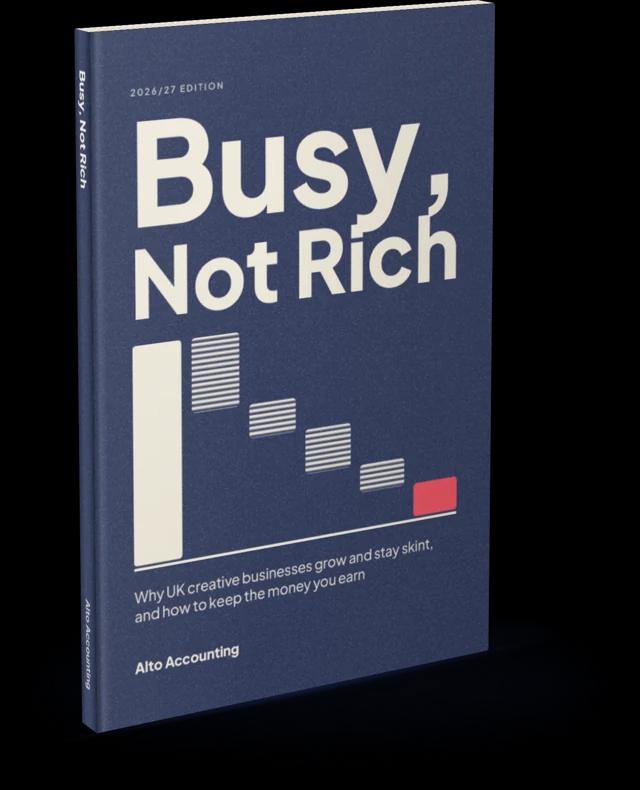
Busy, Not Rich: the free kit
Our book on why UK creative businesses grow and stay skint. The kit puts every chapter's exercise in a workbook for your own numbers, with the 2026/27 tax rates on one page.
Get the free kitEquipment you bought before you incorporated
Photographers weighing a company against staying self-employed can compare how the same kit is claimed in each position in our guide to photographer tax deductions.
If you bought equipment personally before setting up your limited company, the company can still claim it, but not at full cost and not through the Annual Investment Allowance. You control the company, so you and it are connected (section 575(6) Capital Allowances Act 2001), and kit the company buys from you, or you give it, gets no Annual Investment Allowance or first-year allowance (sections 214 and 217). The company's claim is capped at the lower of the kit's market value when it takes it on and what you paid (section 218), and it goes into the main pool for writing down allowances of 14% a year, or the whole balance if the pool is £1,000 or less (sections 56 and 56A). A three-year-old camera is rarely worth what you paid, so the claim is smaller. The 7-year pre-trading rule does not help here: it covers the company's own revenue costs. If the company is taking over a business you ran as a sole trader, a joint election made within 2 years moves the kit across at its tax written-down value instead (section 266). The director's loan account entry, the valuation record and the VAT reclaim window are covered in our guide to claiming a laptop bought before incorporation. Keep that account in credit or at nil: if you later take cash or kit out of the company and the balance goes overdrawn, a balance still unpaid nine months after the year end triggers the section 455 tax charge on an overdrawn directors loan.
Bought equipment before you went Ltd?
Camera, laptop, or studio kit bought before incorporation is still claimable, through writing down allowances on the lower of its market value and what you paid. The valuation and the loan account entry need recording correctly.
Equipment is not the only production cost that trips people up. Wardrobe, costumes and props follow a completely different test from cameras and laptops, our guide to claiming clothes, props and costumes covers where that line sits.
The mobile phone exception, and other mixed-use traps
One mobile phone per director or employee is a specific exception to the personal-use benefit-in-kind rule (section 319 ITEPA 2003): the company can provide one phone, including the handset, line rental, and private call costs, with no benefit-in-kind charge at all, even with significant personal use. HMRC's manual confirms smartphones qualify (EIM21779). Provide a second phone for the same director and that second one becomes a taxable benefit.
Buying the handset outright rather than on a contract adds a VAT wrinkle if you are on the Flat Rate VAT Scheme: a single capital purchase only reclaims VAT if it costs £2,000 or more including VAT. Our guide to buying an iPhone through your company works through that threshold on the 2026 lineup, where some models clear it and others fall just short. The handset it replaces is the other half of the question: handing a used company asset to a director is taxed at the higher of its second-hand value and its value when the company first provided it less 20% for each year since (section 206(3) ITEPA 2003), even if it was tax free while you used it. Our guide to the old company phone on upgrade works through it.
The rule that decides all of this is section 316 ITEPA 2003. Equipment provided only so the job can be done, where private use is not significant, carries no benefit-in-kind. HMRC accepts the test where a written policy sets out what private use is allowed, and says a laptop the job needs is highly unlikely to fail it. Two things break it: buying kit partly so you can use it personally, which fails the sole-purpose condition however little you then use it, and personal use that is more than insignificant, which is where a camera used for paid personal shoots sits. Then budget for the benefit-in-kind charge. For the full picture of what else your limited company can and cannot claim, see our limited company expenses guide.
Corporation Tax relief through the Annual Investment Allowance is separate from VAT recovery. If your studio is buying computer equipment costing £50,000 or more, the VAT treatment used to fall under the Capital Goods Scheme, but our guide to the VAT Capital Goods Scheme explains why that stops mattering for equipment bought from 29 July 2026.
Equipment is not the only way to turn company cash into a Corporation Tax deduction. If you have already used up your capital allowances for the year, the company can also pay employer pension contributions for a limited company director straight to your pension provider, with no income tax or National Insurance charge on the payment.
Getting the AIA claim, the benefit-in-kind assessment, and the VAT position right on every purchase is routine work for Alto's accountant for creative freelancers.
Book a 30-minute call and we will tell you honestly whether your equipment purchases and their personal use are structured the most tax-efficient way for your situation.
Key figures used in this briefing
Annual Investment Allowance (AIA) limit
Full-cost, year-one Corporation Tax deduction for qualifying plant and machinery (computers, cameras, office equipment, most business kit), per company or shared between associated companies, 2026/27. Excludes cars
Benefit-in-kind annual value for a company asset made available for personal use
Where a limited company asset (e.g. equipment bought under AIA) is made available to a director or employee for personal use, and the section 316 work-equipment exemption does not apply, the taxable annual benefit value is 20% of the asset's market value when first made available (section 205(3) ITEPA 2003), plus running costs, taxed on the individual and subject to 15% Class 1A National Insurance (2026/27) paid by the company. Repeats each year the asset stays available for personal use
Frequently asked questions
Can my limited company pay for my laptop?
Yes. Your company can buy a laptop, camera, or other equipment directly, invoice it in the company's name, and claim the full cost against Corporation Tax in the year of purchase under the £1m Annual Investment Allowance (2026/27). The equipment must genuinely be for business use; if you also use it personally and that use is more than insignificant, HMRC treats it as a benefit-in-kind taxed at 20% a year of its market value when the company first provided it, reported on a P11D, but that does not reduce the company's Corporation Tax claim.
What happens if I use company equipment personally as well as for work?
The company still claims the full cost through the Annual Investment Allowance (up to the £1m limit, 2026/27). Separately, if your personal use is more than insignificant, HMRC treats the equipment as a benefit-in-kind: the taxable annual value is 20% of the equipment's market value when the company first made it available to you, plus any running costs the company pays, taxed on you at your marginal Income Tax rate and reported on your P11D, while the company pays Class 1A National Insurance at 15% (2026/27) on that same value. This runs every year the equipment stays available for personal use, not just the year you bought it, so it is worth genuinely keeping personal use insignificant if you want to avoid the ongoing charge.
Can I buy a camera through my limited company?
Yes, provided it is genuinely for business use, such as content production, client work, or studio filming. Cameras, lenses, lighting, and audio equipment all qualify as plant and machinery for the Annual Investment Allowance, the same category as laptops and computers. As with any equipment, invoice it to the company, keep the receipt, and be honest about the split between business and personal use so you know whether a benefit-in-kind charge applies.
Can I claim for equipment I bought before I set up my limited company?
Yes, but not at full cost and not through the Annual Investment Allowance. You control the company, so you and it are connected (section 575(6) Capital Allowances Act 2001), and kit the company buys from you, or you give it, gets no Annual Investment Allowance (sections 214 and 217). The company claims writing down allowances on the lower of the item's market value when it takes it on and what you paid (section 218), crediting the price to your director's loan account. The 7-year pre-trading rule covers only the company's own revenue costs, not kit you bought personally. If the company is taking over your sole trade, a joint election within 2 years moves the kit across at its tax written-down value instead (section 266).
Does the £1m Annual Investment Allowance apply to me?
Yes, if you trade through a UK limited company: the £1m annual limit (2026/27) applies per company, or is shared between associated companies under common control. Almost all equipment a creative business buys, computers, cameras, audio and studio gear, office furniture, qualifies as plant and machinery for AIA. It does not cover cars, which sit in a separate capital allowances pool with rates tied to CO2 emissions.
In short
- The company claims 100% of the equipment cost up to the £1m AIA limit (2026/27). Unlike a sole trader, personal use does not reduce the company's AIA claim.
- Personal use creates a separate, ongoing charge instead. 20% a year of its value when first provided, taxed on the director and costing the company 15% Class 1A NIC, for as long as the personal use continues.
- Kit you owned before the company gets no AIA. You and your company are connected, so it claims writing down allowances on the lower of the kit's market value and what you paid.
- One phone per director is a genuine exception. Fully exempt from the benefit-in-kind rule even with heavy personal use; a second phone is not.
Sources & method
Every rate and rule is sourced to GOV.UK below. The worked example figures are Alto's own illustrative estimates, not GOV.UK figures.