Can my limited company pay for subscriptions? The quick answer
Yes, in the 2026/27 tax year your limited company can pay for subscriptions, and the cost is deductible against Corporation Tax provided it passes HMRC's "wholly and exclusively" test: the subscription must be incurred purely for the purposes of the trade, with no meaningful personal benefit attached. Software tools, professional memberships, and industry publications used for client work generally pass. General entertainment subscriptions (Netflix, Spotify, Audible) almost always fail, because they benefit you as a person as much as, or more than, the business.
For UK creative freelancers going Ltd and small agencies, this question comes up constantly, because so much of the toolkit runs on a subscription: design software, stock libraries, project management, cloud storage. Most of that is genuinely safe to claim. The traps sit at the edges, where a subscription could plausibly be either a business cost or a personal indulgence, and where HMRC applies the most scrutiny.
Professional subscriptions and memberships
Membership of a professional body or trade organisation is a standard, low-risk claim, provided the body appears on HMRC's List 3 of approved professional organisations and learned societies, or you can show the membership is directly relevant to your trade. For UK creative businesses, that covers bodies like D&AD, the Chartered Institute of Marketing (CIM), the Institute of Practitioners in Advertising (IPA), and equivalent design, marketing, and communications associations.
Subscriptions are usually the smallest line in a creative business's claimable costs. For the bigger-ticket items, cameras, laptops, and studio equipment, see our guide to buying equipment through a limited company, which covers full-cost Corporation Tax relief on capital purchases.
The test HMRC applies is whether the business gets a genuine benefit from the membership, not whether you personally enjoy belonging to it. A membership that provides industry accreditation, access to client-facing credentials, or professional standing that supports winning work clears the bar easily. Check the current List 3 on GOV.UK before claiming, since HMRC reviews and updates it periodically, and an unlisted body can still qualify if you can demonstrate the direct trade connection.
A gym membership is the mirror image of a professional body subscription: a genuine, recurring "membership" cost that fails the same wholly and exclusively test a professional body clears easily, because staying fit carries an unavoidable personal benefit. Our guide to gym membership through a limited company covers why it becomes a P11D benefit rather than a deductible subscription, and the one narrow exemption that avoids it.
Software subscriptions and tools: the safe zone
Software subscriptions used for client work are the most straightforward claim available to a creative business. Adobe Creative Cloud, stock photo and footage libraries (Shutterstock, Envato, Getty), project management tools (Asana, Monday, ClickUp), design and prototyping software (Figma, Canva Pro), AI tools (ChatGPT, Claude, Midjourney), cloud storage, and accounting software are all revenue expenses, fully deductible against Corporation Tax in the year paid, with no capital allowance calculation needed.
Where the line gets less clear is a tool with an obvious personal use built in, a premium note-taking app, a general productivity subscription, a personal finance tool, or an AI assistant you also lean on for personal life admin. The same wholly and exclusively test applies, and it works the same way as the streaming trap below: a single subscription used for both client work and your own admin has a dual purpose, so the whole claim is at risk, not just the personal share. Genuine apportionment only works where the cost is separately identifiable, a second licence seat bought only for personal use, or a metered add-on billed apart from the core subscription, not just an estimated personal-use percentage of one blanket subscription. If you genuinely only use it for client work, claim it in full. For the full picture of what else a limited company can claim beyond subscriptions, see our limited company expenses guide.
HMRC Self Assessment checklist for UK YouTube, TikTok, Instagram and OnlyFans creators. Income tracking, allowable expenses, platform reporting rules. Get the free checklist.
The duality-of-purpose trap: Netflix, Spotify, and "research"
Claiming Netflix as "content research" or Spotify as "background music for filming" is a common mistake creative freelancers and small agency owners make with subscriptions. HMRC calls this dual purpose: a cost incurred for more than one reason, where one of those reasons is not the trade. Unlike apportionable costs like mileage or a home office, there is no partial-claim rule for dual-purpose expenditure. If any part of the reason for the subscription is personal, and it usually is, the whole claim fails the wholly and exclusively test, not just the personal share of it.
There is a narrow exception. A working musician analysing streaming data and playlist placement genuinely needs Spotify for the trade. A filmmaker studying competitor documentaries on a streaming platform for a specific commissioned project has a defensible case. The difference is not the platform, it is whether the subscription is doing something the business could not function without, versus something that happens to be useful and that you would have anyway. HMRC will ask you to prove the exclusive business purpose, not just assert it, and a subscription that your household also uses for evening viewing undermines that case immediately. Content creators researching platforms as part of their actual trade have a stronger version of this argument; see our guide to tax deductions for UK content creators for what survives scrutiny. The same dual-purpose logic, under its own specific test, is exactly why most clothing claims fail too, our guide to claiming clothes, props and costumes as a business expense covers the clothing-specific version of this trap.
The tell HMRC actually looks for
A dual-purpose subscription rarely gets disallowed because of what it is. It gets disallowed because of how it is billed. A personal Netflix or Spotify account, on a personal card, in a family plan, that you then claim as an expense reads exactly like what it is: a personal subscription with a business-sounding justification attached after the fact. The claims that survive scrutiny are the ones where the account was set up for the business from day one, on a company card, in the company's name, with a use that maps directly to a specific piece of client or business work.
How to structure the claim correctly
One change does more than any category judgement call: pay for genuinely business-use subscriptions directly from the company, on a company card or company bank account, rather than paying personally and reimbursing yourself later. An invoice or receipt in the company's name, paid by the company, is straightforward evidence of a business cost. A personal subscription reimbursed after the fact forces you to argue intent retrospectively, exactly the position you do not want to be in if HMRC ever asks.
For software and professional subscriptions with a clear, single business purpose (Adobe Creative Cloud used only for client projects, a design association membership), this is a five-minute fix: cancel the personal subscription, resubscribe with the company card and a company email address, and keep the invoice. For anything closer to the dual-purpose line, keep a short note of the specific business use alongside the invoice, which client, which project, which piece of work the subscription supported. That note is worth more than the receipt alone if the claim is ever questioned.
The same whose-name-is-on-it principle decides your mobile phone, and there the stakes are higher than evidence: a contract between the company and the supplier is exempt in full including private calls, while the identical bill on a personal contract paid by the company is a P11D entry. Our briefing on company phone contracts sets out the four arrangements and what each one costs.
Not sure which of your tools are structured correctly?
Most creative businesses run 10 or more recurring subscriptions. A quick review usually finds at least one that is claimed the wrong way, or missed entirely.
VAT reclaim, and what happens if you get it wrong
If your company is VAT registered on the standard scheme, you can reclaim the input VAT, 20% (2026/27), on any subscription that is wholly for business use, in addition to the Corporation Tax deduction. On the Flat Rate Scheme, input VAT on subscriptions is generally not separately reclaimable, since the flat rate percentage already accounts for it, unless the item counts as a capital asset costing £2,000 or more including VAT, which almost no subscription does.
If HMRC challenges a claimed subscription and rules it had a personal element, two things happen, not one. First, the Corporation Tax deduction is disallowed, so the company owes the tax it originally saved. Second, if the subscription was paid directly by the company, HMRC can treat the cost as a benefit-in-kind provided to you personally: Income Tax on the value at your marginal rate, plus 15% Class 1A National Insurance (2026/27) paid by the company on top. Getting the claim disallowed after the fact costs meaningfully more than never claiming it in the first place, which is exactly why the invoice-and-evidence habit above matters more than memorising a list of allowed and disallowed categories.
Chapter 10 of Busy, Not Rich, our book for UK creative business owners, applies the same test more widely: the legitimate costs creative businesses miss, and the claims not worth trying.
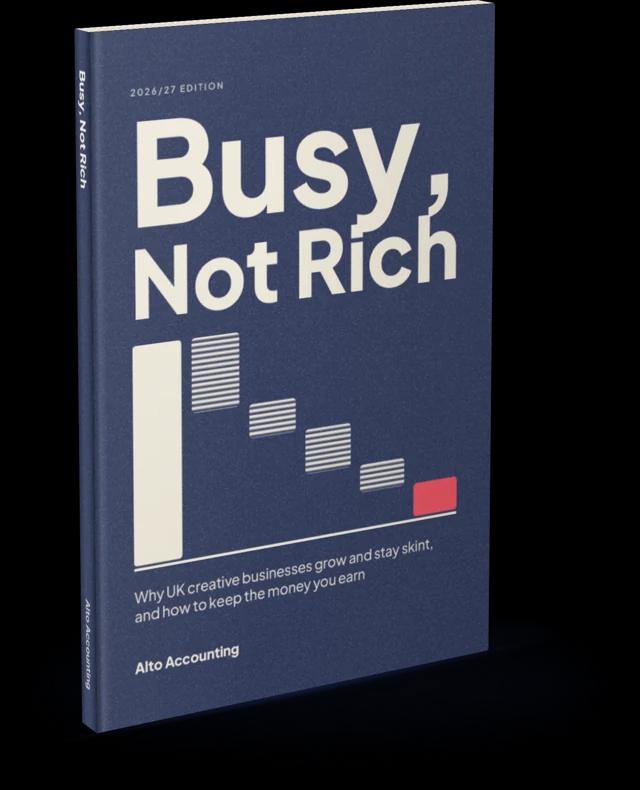
Busy, Not Rich: the free kit
Our book on why UK creative businesses grow and stay skint. The kit puts every chapter's exercise in a workbook for your own numbers, with the 2026/27 tax rates on one page.
Get the free kitKey figures used in this briefing
Corporation Tax Small Profits Rate
For profits of £50,000 or less
VAT Standard Rate
Standard VAT rate in UK, unchanged since 4 January 2011
Class 1A National Insurance rate on P11D benefits in kind, 2026/27
Employer Class 1A NIC rate on the cash equivalent value of taxable benefits reported on P11D and P11D(b), unchanged from 2025/26 (rose from 13.8% to 15% from 6 April 2025)
Book a 30-minute call and we will go through your actual subscription list and tell you honestly what qualifies, what needs restructuring, and what to drop before it becomes an HMRC problem.
Frequently asked questions
Can my limited company pay for subscriptions?
Yes, if the subscription is wholly and exclusively for business purposes. Software tools, professional memberships, and industry publications used for your trade are allowable against Corporation Tax. Subscriptions with a personal element, such as Netflix or Spotify, usually fail this test because they serve you as a person as well as (or instead of) the business, so HMRC disallows the claim unless you can show the use is genuinely, exclusively for the trade.
Can my limited company pay for ChatGPT, Claude, or Midjourney?
Yes, if the subscription is used for the business. AI tools sit in the same category as any other software subscription: a ChatGPT Team seat used for client work, a Claude subscription used for drafting and research, or a Midjourney plan used to produce client imagery are all allowable against Corporation Tax, and the VAT is reclaimable on a valid invoice if the company is VAT registered. The usual wholly and exclusively caveat applies: one personal-tier subscription that doubles as your personal assistant has a dual purpose, and dual-purpose costs fail in full, so where use is genuinely mixed, put the business seat in the company's name on a business plan and keep personal use on a separate personal account.
Can I claim Netflix or Spotify as a business expense through my limited company?
Almost never, and treating it as "research" does not change that. HMRC's wholly and exclusively test fails the moment a cost serves you personally as well as the business, and a general entertainment subscription available to your whole household serves you personally by definition. A narrow exception exists for someone whose trade genuinely depends on the platform, a working musician analysing playlist placements on Spotify, for example, but the bar is high and HMRC will ask you to prove it, not just assert it.
Can I claim professional membership fees through my limited company?
Yes, if the body appears on HMRC's List 3 of approved professional organisations and learned societies, or you can otherwise show the membership is wholly and exclusively for your trade. D&AD, the Chartered Institute of Marketing, and many design and marketing bodies qualify. Check the current List 3 on GOV.UK before claiming, since HMRC updates it periodically and an unlisted body can still qualify case by case if the link to your trade is direct.
What happens if HMRC decides a subscription had personal use?
If the subscription was paid by the company but had a dual purpose, HMRC disallows the Corporation Tax deduction and can treat the cost as a benefit-in-kind provided to you personally. That means Income Tax on the value for you and Class 1A National Insurance at 15% (2026/27) for the company, on top of losing the deduction you claimed in the first place. Getting caught costs more than never claiming it.
Can I reclaim VAT on business subscriptions?
Yes, if your company is VAT registered on the standard scheme and the subscription is wholly for business use, you can reclaim the input VAT (20%, 2026/27) shown on the invoice. On the Flat Rate Scheme, you generally cannot reclaim input VAT on subscriptions unless the item counts as a capital asset costing £2,000 or more including VAT, which most subscriptions do not.
What records do I need to keep for a subscription expense claim?
Keep the invoice or receipt showing the company as the customer, evidence the account is billed to a company card or company-paid method rather than reimbursed from a personal account, and a note of how the subscription is used in the business. For anything with a plausible personal use (design tools, stock libraries, streaming platforms), that business-use note matters most if HMRC ever asks. Keep records for at least six years.
In short
- Wholly and exclusively is the whole test. Software, tools, and professional memberships used only for business pass easily; anything with a personal use attached usually fails entirely, not partially.
- Netflix and Spotify claimed as "research" almost never survive an enquiry. The narrow exception is a trade that genuinely cannot function without the platform, and HMRC expects proof, not assertion.
- How you pay matters as much as what you buy. A subscription billed to the company from day one reads very differently to a personal subscription reimbursed after the fact.
- Getting it wrong costs more than not claiming. A disallowed claim means losing the Corporation Tax deduction plus Income Tax and 15% Class 1A NIC (2026/27) if HMRC treats it as a personal benefit.
Sources & method
Every rate and rule is sourced to GOV.UK below.